

What We've Learned Installing Concrete Curbing in Winnipeg
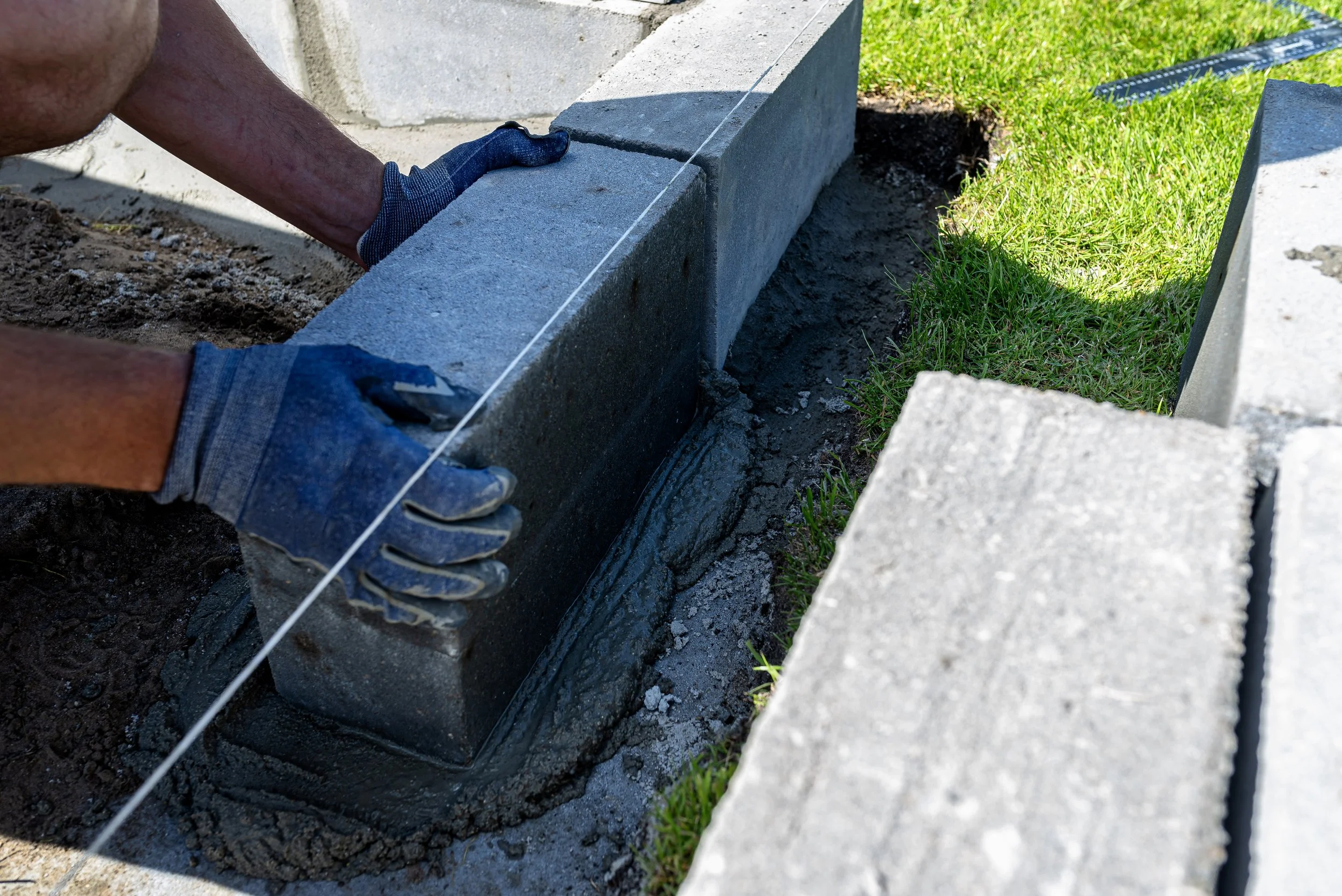
Concrete Curbing Looks Simple Until Winnipeg's First Winter Tests It
Concrete curb landscape edging is one of those features that looks straightforward until you've installed it in a climate where the ground freezes four feet deep every winter. The finished product is clean, permanent-looking, and immediately improves the definition between lawn and garden beds. Then spring arrives in Winnipeg, and the sections that weren't installed correctly announce themselves clearly: a lifted corner here, a crack across a curved section there, a gap that opened between two runs that were tight in October.
The lessons in this guide come from years of installing concrete curbing across Winnipeg properties and observing what holds through multiple winters and what doesn't. The variables that determine performance are mostly invisible at installation, which is exactly why they're worth understanding before any concrete gets mixed.
Key Takeaways
Concrete curb landscape edging performance in Winnipeg is determined primarily by base preparation, concrete mix specifications, and joint placement — all invisible once installed
Freeze-thaw cycling in Manitoba is the primary stress that separates correctly installed curbing from incorrectly installed curbing
Continuous concrete curbing without adequate control joints will crack — the question is where, not whether
Colour integral concrete curbing requires specific mix and sealing attention in Winnipeg's climate to maintain appearance over time
Professional installation with proper base preparation and joint planning delivers 20-plus year performance that DIY and budget installations typically don't approach
Bulger Brothers Landscape installs concrete curbing across Winnipeg with the specifications Manitoba's climate demands
Overview: What Makes Concrete Curbing Work in Winnipeg
Concrete curb landscape edging has genuine advantages over plastic, metal, and brick edging alternatives when it's installed correctly in Winnipeg's climate. It's permanent, defines curves cleanly, requires no annual reinstallation, and provides a continuous, clean edge that keeps lawn from creeping into beds and bed material from washing into the lawn. When it's installed incorrectly, it creates an ongoing repair cycle that undermines every one of those advantages.
This guide covers what we've learned about the specific installation requirements that determine performance in Manitoba, what the most common failure patterns look like and why they happen, and what to look for in any contractor you're evaluating for concrete curbing work.
Bulger Brothers Landscape installs concrete landscape edging for residential and commercial properties across Winnipeg, and the installation standards in this guide reflect what the local climate requires.
What We've Learned About Base Preparation
The first lesson from installing concrete curbing in Winnipeg is that base preparation matters as much as the concrete itself, and it's the step most often compromised on budget installations.
The problem with curbing directly on disturbed soil: Machine-extruded concrete curbing, the method used by most professional curbing installers, is placed on a prepared surface in a continuous run. The curbing machine rides along the line and extrudes a concrete profile as it moves. If the surface underneath isn't adequately prepared and stable, the curbing settles unevenly as the soil beneath it compacts through the first seasons after installation. This settling appears as sections that have dropped slightly below adjacent sections, creating the appearance of a wavy line rather than a smooth continuous curve.
What adequate base preparation looks like: The path of the curbing should be excavated to remove loose, recently disturbed, or organically rich soil and replaced with a layer of compacted granular material that provides a stable, uniform base. This isn't a deep excavation, but it needs to ensure that the concrete is sitting on a surface that won't compress differentially through the first two or three seasons.
The clay soil factor: Winnipeg's clay soil is more prone to this differential settling than sandier soils because clay holds moisture variably depending on the drainage patterns around it. Sections of curbing near downspouts, in low-lying areas, or adjacent to tree root zones settle differently than sections in drier, more stable areas. Base preparation that removes the clay from the curbing's direct support zone and replaces it with stable granular material reduces this differential behaviour significantly.
What We've Learned About Concrete Mix in Winnipeg
Not all concrete performs equally in freeze-thaw conditions, and the mix used for landscape curbing in Manitoba needs to meet specific performance standards that entry-level or builder-grade mixes don't achieve.
Air entrainment is essential. As covered in our discussion of concrete patios, air-entrained concrete contains microscopic air bubbles that provide space for water to expand as it freezes within the concrete, preventing the internal pressure that causes surface scaling and spalling. For concrete curbing in Winnipeg, air entrainment is the single most important mix specification. Curbing installed without an air-entrained mix in this climate will show surface scaling and deterioration within three to five years.
Water-cement ratio affects durability. A lower water-cement ratio produces denser, more durable concrete with less pore space for water infiltration. On-site addition of water to concrete mixes to improve workability, which is a common practice among less careful installers, increases the water-cement ratio and reduces the concrete's freeze-thaw resistance. The correct approach is using appropriate admixtures to improve workability without adding water.
Coloured curbing requires additional specification attention. Integral colour concrete curbing is popular because the colour extends through the full profile rather than being a surface coating that wears off. Achieving good colour depth and consistency requires specific pigment loading in the mix that can't be added casually. In Winnipeg, the UV exposure through summer combined with the surface stress of freeze-thaw cycling makes colour retention in integral colour curbing more demanding than in milder climates. Coloured curbing that starts deep and rich can fade to a washed-out grey within a few seasons if the mix specification and sealing program aren't adequate.
What We've Learned About Control Joints
This is the lesson that catches the most homeowners and installers off guard: continuous concrete curbing without control joints will crack. Concrete shrinks slightly as it cures, expands and contracts with temperature changes through the day and through the seasons, and receives differential movement from the soil and frost activity beneath it. All of these forces create internal stress that, when it exceeds the concrete's tensile capacity, produces cracking.
Control joints don't prevent cracking. They direct it. A control joint is a deliberately created weak plane in the concrete that encourages cracking to occur along the joint line rather than randomly across the visible face of the curbing. Properly spaced control joints make cracking predictable, manageable, and essentially invisible because the joint itself is already a defined line in the product.
What we've observed about joint spacing in Winnipeg: Machine-extruded concrete curbing without control joints in Winnipeg's climate develops random cracking through faces and curved sections typically within the first two winters. The cracks may be minor initially and become more pronounced over subsequent freeze-thaw cycles as water enters the crack, freezes, expands, and widens it.
Appropriate joint spacing varies by curbing profile and dimensions, but for standard residential landscape curbing, a joint interval of approximately every 1.5 to 2 metres provides adequate cracking control. In areas where the curbing transitions between straight runs and curved sections, additional joints at the transition points manage the differential stress that these geometry changes create.
Hand-tooled joints versus saw-cut joints: On machine-extruded curbing, joints are typically tooled by hand into the fresh concrete shortly after installation, creating the defined weak plane before the concrete reaches full strength. This is standard practice for professional curbing installers. Saw-cut joints, which are cut after the concrete has hardened, are also used on larger-profile curbing. Both methods are effective when done at the correct interval and depth.
What We've Learned About Curves and Geometry
Curved concrete landscape edging is one of the primary aesthetic advantages of this product over straight-only metal and plastic alternatives. The ability to follow any curve — tight radii around tree islands, sweeping curves defining large bed areas — is what makes concrete curbing so visually effective in garden design. Curves also create specific installation challenges in Winnipeg that straight runs don't.
Tight curves concentrate freeze-thaw stress. The inside radius of a tight curve in concrete curbing concentrates compressive stress differently than a straight run. When the concrete expands with temperature increase or when frost works against the outside of the curve, the inside of the curve receives concentrated stress that can produce cracking at the curve apex if joints aren't placed thoughtfully around the curve geometry.
Ground preparation on the inside of tight curves matters more. The soil on the inside of a tight curve needs to be particularly stable because differential settlement on the inside of a curve produces a more visually obvious result than settlement on a straight section. A section that drops 5 mm on a straight run is hard to see. The same drop on the inside of a tight curve is visible as a kink in what should be a smooth arc.
What We've Learned About Sealing Concrete Curbing in Winnipeg
Sealing concrete curbing is the maintenance practice that most extends service life in Winnipeg's climate and the practice most commonly omitted by homeowners after installation.
The mechanism matters for understanding: Surface sealers reduce water infiltration into the concrete's pore structure. Water that infiltrates a concrete surface and then freezes within the pores during a cold event expands and creates internal pressure that damages the surface. This is the process that produces the scaling and flaking appearance common on unsealed exterior concrete in cold climates. A properly applied penetrating sealer reduces this infiltration, protecting the surface from the primary freeze-thaw damage mechanism.
Timing matters: Concrete curbing should be sealed after the concrete has reached design strength, typically 28 days after installation. Sealing too early traps moisture within the curing concrete. Sealing too late allows the unprotected surface to go through its first winter cycle without protection.
Reapplication schedule: Penetrating concrete sealers deplete over time as they're exposed to UV, foot traffic, and weather. Reapplication every two to three years maintains the protection level. This is a modest maintenance investment that significantly extends the surface appearance and performance of concrete curbing through Winnipeg winters.
Coloured curbing and sealing: For integral colour concrete curbing, sealing serves a dual purpose of protecting the surface and enhancing colour depth. A freshly sealed coloured curbing installation looks richer and more vibrant than an unsealed equivalent, and maintains that appearance better over time.
What We've Learned About Integration With Garden Beds
Concrete curb landscape edging performs as a design element as much as a functional one, and how it integrates with the beds it defines affects both appearance and performance.
Mulch depth management matters. The standard concrete curbing profile sits approximately 10 to 15 cm above finished grade, with some profile buried in the ground for stability. Mulch applications in the bed should stay below the curbing height rather than piling against it. Mulch consistently pushed against the concrete face retains moisture against the surface and accelerates the freeze-thaw damage cycle on that face.
Lawn edge management affects appearance. Grass that grows over the curbing top face obscures the clean line that's the product's primary visual contribution. Regular lawn edging to keep grass from overgrowing the curbing maintains the clean visual separation between lawn and bed that makes concrete curbing worth the investment.
Bed elevation and curbing height selection. For beds where soil or mulch level is significantly elevated above lawn grade, the curbing height selection needs to account for this elevation difference. A bed that's 15 cm higher than the adjacent lawn needs a curbing profile that effectively contains that height difference without looking like a retaining wall rather than an edging feature.
For broader context on how concrete curbing integrates with professional bed and mulch installation services in Winnipeg, that overview covers how professional bed management works alongside edging features.
Understanding concrete landscaping services more broadly in Winnipeg gives homeowners the context for how curbing fits within the full range of concrete-based outdoor features.
What to Ask Any Concrete Curbing Contractor in Winnipeg
Based on everything in this guide, these are the questions that most reliably identify contractors who install curbing correctly in Winnipeg's climate:
What base preparation do you do before installing the curbing? A contractor who describes excavating and replacing disturbed or organic soil with stable granular base material is thinking about long-term performance. One who describes running the machine over existing soil without preparation is not.
What concrete mix do you use and is it air-entrained? Air-entrained mix for exterior concrete in Manitoba is a baseline requirement. A contractor who can confirm this specification is working with the right material. One who doesn't know what air entrainment is or why it matters is a flag.
What control joint spacing do you use and how are they installed? A specific answer describing tooled or saw-cut joints at intervals of 1.5 to 2 metres demonstrates understanding of why joints matter. Vague responses about joints being optional or installed "where needed" indicate inadequate attention to the most important cracking management practice.
Do you seal the curbing after installation and what's your recommendation for maintenance sealing? A contractor who includes or recommends sealing as part of the complete installation demonstrates understanding of the surface protection needs. One who installs and leaves without sealing guidance is leaving the most important long-term maintenance practice unaddressed.
For context on how concrete curbing costs fit within the broader landscape of hardscape installation costs in Winnipeg, that guide covers pricing across all hardscape categories.
When you're ready to install concrete curb landscape edging that holds up through Winnipeg winters, Bulger Brothers Landscape provides installation with the base preparation, mix specifications, joint planning, and sealing that Manitoba's climate requires. Located at 7 Leeward Pl, Winnipeg, MB R3X 1M6, the team installs concrete curbing with the same construction discipline applied to every outdoor project. Call (204) 782-0313 to discuss your project and get a quote that reflects what correct installation in this climate actually involves.
Frequently Asked Questions About Concrete Curb Landscape Edging
Q: How long does concrete curb landscape edging last in Winnipeg?
A: Correctly installed concrete curbing with air-entrained mix, adequate base preparation, appropriate control joint spacing, and regular sealing typically lasts 20 to 30 years or more in Winnipeg. Improperly installed curbing without these specifications often shows significant cracking, scaling, and lifting within five to ten years.
Q: Why does concrete curbing crack in Winnipeg?
A: The primary causes are inadequate control joint spacing that doesn't manage the stress from thermal expansion and contraction and frost movement, and concrete without adequate air entrainment that's vulnerable to internal freeze-thaw damage. Both are installation decisions invisible at completion and visible after the first few winters.
Q: Can concrete curbing be repaired after it cracks?
A: Minor cracks can be filled with flexible concrete caulk as a maintenance measure to prevent water infiltration and crack propagation. Sections that have heaved significantly, broken through the face, or separated from adjacent sections typically require removal and reinstallation. The repair option for significant failure is always more limited and more expensive than correct original installation.
Q: Is concrete curbing better than plastic or metal edging in Winnipeg?
A: Correctly installed concrete curbing is more permanent and visually refined than plastic or metal alternatives and doesn't require the annual reinstallation that frost-heaved plastic edging often does. The trade-off is higher upfront installation cost and the importance of correct installation for long-term performance. Plastic and metal alternatives are more forgiving of installation variation because they can be reset annually.
Q: How much does concrete curb landscape edging cost in Winnipeg?
A: Professional machine-extruded concrete curbing typically costs $12 to $20 per linear foot installed, with coloured curbing at the higher end of that range. Projects with significant curves, tight access, or extensive base preparation requirements may run higher. Getting a specific quote based on your property's layout is more accurate than applying a per-linear-foot estimate without site assessment.
Q: Does concrete curbing need to be sealed in Winnipeg?
A: Yes. Sealing after initial cure and every two to three years thereafter reduces water infiltration into the concrete surface, protecting against the freeze-thaw surface damage that unsealed exterior concrete experiences in Manitoba's climate. For coloured curbing, sealing also maintains colour depth and vibrancy over time.
Q: Can concrete curbing be installed in fall in Winnipeg?
A: Yes, through approximately mid-October in a typical year, as long as temperatures during and after installation stay above freezing for an adequate curing period. Fresh concrete should not be allowed to freeze during the initial cure. Later fall installations risk cold-weather curing complications and are typically deferred to spring.
Q: Is concrete curbing maintenance-free once installed?
A: Not completely. Regular sealing every two to three years is the primary ongoing maintenance requirement. Keeping mulch below the curbing face rather than piled against it, and managing lawn edge growth over the curbing top, maintains the appearance and reduces the moisture exposure that accelerates surface deterioration.
Conclusion
Concrete curb landscape edging in Winnipeg is a genuinely excellent product when it's installed correctly and a frustrating repair cycle when it isn't. The difference between those two outcomes is determined by base preparation quality, concrete mix specifications including air entrainment, control joint spacing and execution, and post-installation sealing — all invisible at the time of installation and all fully visible after two or three Manitoba winters have tested what was actually built. The questions in this guide are the ones worth asking any contractor before concrete gets mixed, because the answers tell you whether you're hiring someone who understands what Winnipeg's climate demands or someone who's applying standards that work somewhere else. Bulger Brothers Landscape installs concrete curbing to the specifications this climate requires, and welcomes every question on that list.